

Half a century is an eternity in aviation.
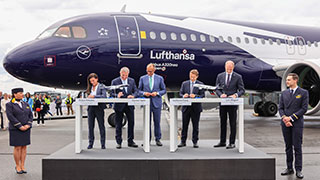
At the ILA Berlin Air Show 2026, Airbus and Lufthansa Group marked fifty years of cooperation — a relationship that began in 1976 when Lufthansa became the launch customer of the Airbus A300. At the time, Airbus was still a young European challenger attempting to compete with the established American giants. Today it stands among the world's leading aircraft manufacturers.
The anniversary is more than symbolic. Later this year Airbus is expected to deliver its 700th aircraft to Lufthansa Group, making this one of the largest and longest-standing airline-manufacturer relationships in commercial aviation.
Over the past five decades Lufthansa has operated virtually every major Airbus aircraft family, from the A220 and A320 series to the A330, A340, A350 and A380. The German carrier has repeatedly served as an early customer for new Airbus programs, helping shape aircraft development and technological innovation across the industry.
The celebrations in Berlin were accompanied by several new agreements designed to strengthen cooperation further. Lufthansa signed a comprehensive component support contract covering its entire Airbus A220 fleet, aimed at improving maintenance efficiency and operational reliability throughout the group.
More importantly, both companies reaffirmed their commitment to the future of sustainable aviation. Among the technologies showcased was Airbus' innovative SharkSkin surface coating for the A330. Inspired by the microscopic structure of shark skin, the technology reduces aerodynamic drag, lowers fuel consumption and helps decrease emissions without requiring major structural modifications to the aircraft.
The announcement comes as Lufthansa continues to expand its Airbus fleet. The group recently finalized an order for ten additional Airbus A350-900 aircraft, bringing its total A350 commitment to seventy-five aircraft, including future deliveries of the larger A350-1000 variant.
The significance of Lufthansa's continued investment in the Airbus A350 extends far beyond fleet renewal.
Modern aircraft are, first and foremost, economic machines.
Compared with previous-generation widebody aircraft, the Airbus A350 consumes approximately 25% less fuel, requires less maintenance and offers greater operational reliability. For an airline, this means lower operating costs on every flight, improved profit margins and greater resilience during periods of volatile fuel prices.
The advantages become even more significant at scale. When an airline operates dozens of aircraft flying thousands of routes each year, even a small reduction in fuel consumption translates into hundreds of millions of euros in savings over the lifetime of the fleet.
New-generation aircraft also provide longer range, lower emissions and improved passenger comfort, allowing airlines to serve more destinations while meeting increasingly demanding environmental standards.
In other words, Lufthansa is not merely buying airplanes.
It is buying lower costs, higher efficiency and stronger competitiveness for the next twenty years.
The agreements were signed in the presence of German Chancellor Friedrich Merz, underlining the strategic importance of aerospace manufacturing not only for Germany but for Europe as a whole.
In an era when headlines are dominated by geopolitical tensions and short-term market fluctuations, Airbus and Lufthansa are making decisions measured not in quarters but in decades. That alone may be the most important message from Berlin.
Andrievskii Verdict
Every new Airbus A350 entering Lufthansa's fleet lowers fuel consumption, reduces maintenance costs and improves operating efficiency for decades to come. This is not an expense. It is a long-term investment in profitability.
A modern Airbus A350 is, in many respects, a flying cost-reduction machine.
While markets remain focused on short-term headlines, airline management teams continue investing billions in aircraft capable of generating substantial savings throughout their operating lives.
When one of Europe's largest airlines continues ordering dozens of the most fuel-efficient aircraft available, management may be telling shareholders something that the market has not fully priced in yet.
Investors often search for miracles in technology stocks while overlooking a rather obvious fact: Lufthansa's management appears convinced that saving 25% on fuel is a good business model. Judging by recent aircraft orders, they seem willing to bet billions on it.
The aviation business has always been cyclical. Efficiency, however, compounds.
And the cheapest fuel is still the fuel you never have to burn.
Aleksei Andrievskii | Advisory Board Member, Bendura Bank AG | Liechtenstein