

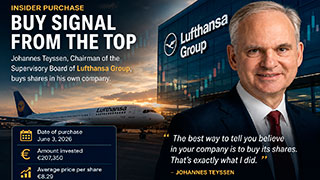
Insider purchases rarely guarantee success. But they always deserve attention — especially when the buyer is the chairman of Europe's largest airline group.
Financial markets have a curious habit. The cheaper a company becomes, the more experts appear to explain why its shares should become even cheaper. Few sectors illustrate this phenomenon better than aviation. Over the past several years, investors have been told about the end of affordable air travel, the lasting consequences of the pandemic, soaring fuel costs, geopolitical conflicts, economic stagnation and a dozen other reasons why European airlines supposedly had no future. Throughout this period, however, aircraft continued to fly, airports remained crowded and millions of passengers continued to travel for business, leisure and everything in between.
This is precisely why insider transactions attract so much attention. Unlike analysts, who risk little more than the accuracy of their forecasts, corporate insiders put their own capital at stake. Earlier this month, Dr Johannes Teyssen, Chairman of the Supervisory Board of Lufthansa Group, purchased approximately €207,350 worth of Lufthansa shares on the open market at an average price of €8.29 per share. The transaction was not related to stock options, executive compensation or any corporate incentive programme. It was a straightforward purchase using his own money.
The size of the transaction alone will not change Lufthansa's future, nor does it guarantee a higher share price. What makes the purchase noteworthy is the identity of the buyer. Johannes Teyssen is not a newly appointed executive looking to make a symbolic gesture. He spent more than a decade leading E.ON, one of Europe's largest energy companies, overseeing a business with tens of billions of euros in revenue through economic cycles, energy crises, regulatory upheavals and large-scale corporate transformations. Individuals with that level of experience rarely feel compelled to buy assets they consider expensive.
The timing is equally interesting. The aviation sector continues to be viewed through the lens of yesterday's fears. Many investors remain focused on the disruptions of recent years, as if the future must inevitably resemble the past. Yet the landscape is gradually changing. Aviation fuel prices are well below the extreme levels seen during previous crises. International tourism continues to recover. Passenger demand remains resilient. Any further reduction in geopolitical tensions surrounding Ukraine or the Middle East would provide an additional tailwind for the sector. Nevertheless, market sentiment often lags reality, and it is precisely during such periods that the most attractive investment opportunities tend to emerge.
History shows that substantial investment returns are often generated not when optimism is widespread, but when expectations begin to improve from excessively pessimistic levels. Markets frequently spend too much time analysing what has gone wrong and too little time considering what might go right. While many analysts remain preoccupied with risks, experienced investors tend to focus on the possibility that future conditions may prove better than current expectations suggest.
One cannot help but notice the contrast. While some market commentators continue to debate whether European aviation remains investable, the Chairman of Lufthansa has chosen to become a buyer. There is a significant difference between writing a report about a company and purchasing its shares with personal capital. The first requires an opinion. The second requires conviction.
Andrievskii Verdict
I have always found insider purchases more informative than market commentary. Analysts can be wrong without consequence. Corporate insiders pay for their mistakes themselves.
A single purchase does not guarantee future performance, and investors should never base decisions solely on insider activity. However, when the Chairman of Europe's largest airline group begins accumulating shares shortly after taking office, it deserves attention.
Markets are currently asking whether conditions might deteriorate.
Successful investors often ask a different question.
What happens if conditions turn out to be better than expected?
Perhaps that is exactly the question Johannes Teyssen is asking today.
Aleksei Andrievskii | Advisory Board Member, Bendura Bank AG | Liechtenstein