

On why Wall Street will always find a new way to sell the oldest human weakness
It is said that, these days, the Devil has become rather bored. People no longer sell their souls. Subscriptions, trading apps and smartphone notifications have replaced that business entirely.
And so, one spring evening, Woland decided to host a new grand ball. Not in 1930s Moscow. Not even at the Variety Theatre. But on Wall Street itself.
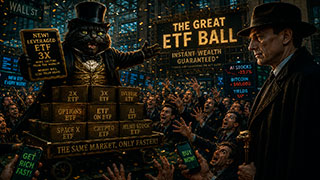
The master of ceremonies was appointed immediately. The enormous black cat Behemoth arrived in a top hat, carrying a golden tablet under his arm and wearing such a self-satisfied expression that one might think he had just invented another ETF.
“Ladies and gentlemen,” he announced, “today we shall liberate you from boredom, patience, and long-term thinking!”
The audience erupted into applause.
“And most importantly,” the cat continued, “nobody will lose their head.”
This declaration was greeted with even greater enthusiasm. People have always loved promises that cost nothing to make.
The entertainment began.
First came the cryptocurrencies. They resembled travelling magicians from a provincial circus. Each promised to turn a copper coin into gold. Preferably before the market close.
Then came the meme stocks. They possessed neither earnings, nor dividends, nor any obvious connection to reality. Yet they rose magnificently on photographs of dogs, rockets and the excitement of investors who had never opened a financial statement.
The crowd was delighted.
But the true triumph came later.
Behemoth rolled onto the stage an enormous cart. Upon it lay ETFs. Not ordinary ETFs. Leveraged ETFs. Triple-leveraged ETFs. Inverse ETFs. Option-based ETFs. ETFs invested in other ETFs. And, according to some witnesses, ETFs invested in ETFs that invested in ETFs created to purchase other ETFs.
“Buy them!” shouted Behemoth. “It is the same market, only faster!”
“How much faster?” asked a nervous voice from the back of the hall.
“Fast enough to make your money disappear completely.”
Unfortunately, the audience missed that part because of the applause. Even had they heard it, few would have cared. Nothing excites mankind quite as much as the possibility of becoming rich quickly. Especially when a well-dressed gentleman assures them that risk has finally been conquered by mathematics.
Many investors concluded that the philosopher’s stone of finance had at last been discovered. Why own a company when you can own a fund that owns the company? Why own a fund that owns the company when you can own a triple-leveraged fund that owns a fund that owns the company? And if that still seems insufficiently exciting, one can always add options.
The logic appeared flawless.
At least until the music stopped.
One day artificial intelligence stocks suffered one of their sharpest declines in months. Bitcoin fell. Bond yields surged. And traders suddenly remembered that central banks occasionally exist to ruin parties.
The ballroom became noticeably quieter.
Behemoth studied the screens. Then the crowd. Then the screens once more.
“How curious,” he remarked. “It seems that some of you have lost your heads after all.”
“But you promised!”
“Indeed,” replied the cat. “I promised nobody would remove them. I never said you could not lose them yourselves.”
Woland nodded approvingly.
Meanwhile, the temptations multiplied. Competition for the attention of retail investors became fiercer than ever. First cryptocurrencies. Then meme stocks. Then zero-day options. Then leveraged ETFs. Then artificial intelligence. Then prediction markets.
Every week produced a new religion. Every month a new prophet. Every quarter a new road to wealth.
In recent months alone, hundreds of new ETFs have been launched in the United States. Humanity has never manufactured so many financial temptations. Even medieval alchemists worked more modestly.
Behemoth was particularly fond of the SpaceX story. The company had not yet gone public. Yet ETFs devoted to it already existed. Leveraged versions existed. Inverse versions existed. Options strategies existed. Only an ETF investing in future ETFs investing in future SpaceX shares remained missing. But that, everyone agreed, was merely a matter of time.
OpenAI would likely receive similar treatment. Anthropic as well. And many other companies that currently exist more vividly in investors’ imaginations than on public markets.
The crowd demanded miracles. The industry was delighted to supply them.
Such is the central law of modern finance:
If there is demand for a dream, someone will create an exchange-traded fund to package it.
Particularly touching is the behaviour of retail investors. Studies consistently show that most buy what has already risen. When a stock rises 200%, they become interested in the business. When it rises 500%, they begin to regard it as safe. When it falls 80%, they suddenly discover the existence of fundamental analysis.
So it was yesterday. So it is today. So it shall likely remain tomorrow.
For the most valuable commodity in modern finance is neither stock nor bond nor cryptocurrency. It is attention. And attention, as it happens, is the only asset people willingly surrender for free to those intending to sell them something expensive.
Thousands of funds compete for it. Hundreds of analysts. Millions of influencers. Entire armies of algorithms. All fighting for a few seconds of human focus. All promising wealth. And the louder the story becomes, the more likely it is that nothing stands behind it.
Toward the end of the evening, Woland walked to the window. Below him the market roared. Prices flashed across screens. Investors rushed from one fashionable idea to the next. From cryptocurrencies to artificial intelligence. From artificial intelligence to ETFs. From ETFs to the next great miracle not yet invented.
“Tell me, my dear Woland,” asked Behemoth, “does there exist any reliable way to preserve capital?”
Woland gazed silently at the lights of the financial district.
Then he smiled.
“Of course.”
“And what might that be?”
“Never confuse investing with entertainment.”
For a moment, Behemoth said nothing. He glanced at his brochures. His leveraged ETFs. His promises of effortless wealth. And for the first time all evening, he seemed slightly embarrassed. Only slightly.
“Tomorrow we launch a new fund, my dear Woland.”
“And what does it invest in?”
The cat straightened his whiskers.
“Human greed.”
Woland looked out the window. A queue had already formed outside.
“And who will buy it?”
Behemoth blinked in surprise.
“Everyone.”
“The very same people who lost money in the previous fund invested in human greed.”
Woland laughed quietly.
“Then,” he said, “that is truly an eternal business.”
Aleksei Andrievskii is the founder of the ANDRIEVSKII SEA WEALTH family office in Cyprus, a member of the advisory board at Bendura Bank AG, Liechtenstein