

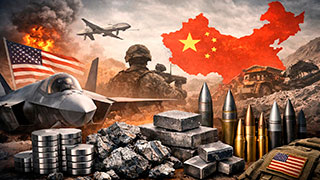
When Washington quietly informed its European allies about delays in deliveries of critical weapons systems, the explanation seemed straightforward: operational urgency in the Middle East. But beneath the surface lies a far more structural issue—one that has little to do with battlefield tactics and far more to do with geology, supply chains, and strategic dependency.
This is not merely a logistics problem. It is a resource crisis.
Arsenal Under Strain
U.S. officials have begun redirecting contracted deliveries of advanced systems—including Patriot (PAC-3) interceptors and JASSM-ER cruise missiles—to operations tied to escalating tensions with Iran. Reports suggest that during the initial phase of Operation Epic Fury, more than 1,000 precision-guided munitions were deployed within weeks.
Such consumption levels are unprecedented in modern warfare. Yet the true constraint is not just production capacity—it is the availability of the materials that make these systems possible.
Modern weapons are, at their core, resource-dependent technologies:
Tungsten provides the density and penetration required for kinetic energy systems.
Rare earth elements (REEs) are essential for guidance systems, sensors, and propulsion.
Without these inputs, even the most advanced defense manufacturing lines stall.
Beijing’s Mineral Leverage
China currently dominates the field, controlling over 80% of global processing capacity for tungsten and rare earth elements. Recent tightening of export licensing rules has effectively created a controlled bottleneck—what industry experts increasingly describe as a “mineral blockade.”
This is not a formal embargo. It is more precise—and arguably more effective. By restricting processing volumes rather than banning exports outright, Beijing exerts pressure without triggering traditional trade retaliation mechanisms.
The result: longer production timelines, rising costs, and growing uncertainty across Western defense supply chains.
The Rise of Strategic Assets
Against this backdrop, a reassessment is underway. A number of mining and resource companies are no longer viewed simply as commodity producers, but as pillars of national security infrastructure.
Guardian Metal Resources (LSE: GMET.L) — Through its Pilot Mountain project in Nevada, the company controls the largest undeveloped tungsten deposit in the United States. With expanded drilling permits, it is increasingly seen as a cornerstone of U.S. supply chain independence.
American Tungsten Corp. — Backed by over $40 million in investment, the company is reviving the historic IMA mine in Idaho, aiming to become the first domestic tungsten producer in more than a decade.
Tungsten West (LSE: WTG) — Operator of the Hemerdon mine in the UK, the company is securing fresh funding to transform the site into a NATO-aligned supply hub.
Strategic Minerals PLC (LSE: SML) — Its Redmoor project in Cornwall is gaining traction as a high-grade European source, attracting attention from defense contractors seeking reliable inputs.
The Push for Global Diversification
Western governments and industry players are accelerating diversification efforts:
EQ Resources (ASX: EQR) is scaling output through assets in Australia and Spain.
Tungsten Mining NL (ASX: TGN) is advancing the Mt Mulgine project as a long-term reserve base.
Almonty Industries (TSX: AII / ALL.TO) is developing the Sangdong mine in South Korea—one of the largest tungsten projects outside China.
Processing: The Critical Bottleneck
Mining alone will not solve the problem.
Processing remains the decisive choke point—and it is still dominated by China.
Neo Performance Materials (TSX: NEO / NCF.TO) operates Europe’s only rare earth processing facility in Estonia, positioning the company at the center of high-performance magnet production for missile systems and advanced aircraft.
Without sufficient processing capacity, raw materials cannot be converted into usable defense components—making this segment arguably the most strategically vital of all.
Andrievskii Verdict
The era of “just-in-time” defense procurement is over.
Washington is confronting a new strategic reality: military power is no longer defined solely by platforms—aircraft carriers, fighter jets, or missile systems—but by the resilience of the supply chains behind them.
Markets are already adjusting. Companies once viewed as cyclical mining plays are being reclassified as critical infrastructure assets.
Until projects like Pilot Mountain and Sangdong reach full operational capacity, Europe is likely to remain a secondary priority in the allocation of advanced weapons systems.
In the emerging geopolitical order, a wall of minerals may prove just as decisive as a missile shield.
Aleksei Andrievskii is the founder of the ANDRIEVSKII SEA WEALTH family office in Cyprus, a member of the advisory board at Bendura Bank AG, Liechtenstein