

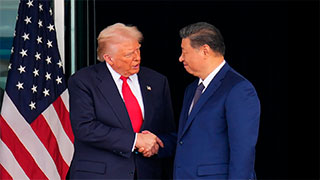
Donald Trump sounded triumphant afterwards. But in his first meeting with Chinese counterpart Xi Jinping since returning to office in January, the US president had to give at least as much as he got.
Trump declared the two leaders had “settled” their differences on one of the thorniest issues, and a major source of Beijing’s leverage: access to China’s rare earths. “There’s no roadblock at all on rare earth,” he said Thursday aboard Air Force One. “That will hopefully disappear from our vocabulary for a little while.”
What Trump chalked up as a win — for the global economy as well as the US — was China’s agreement to wait one year before implementing a sweeping regime of export controls for critical minerals that are crucial in all kinds of industries.
But those new curbs are still in the pipeline, and older ones still in place – meaning that companies in the US and beyond will remain at Beijing’s mercy for key inputs needed to make fighter jets, semiconductors and electric cars. Only a much more comprehensive deal between the world’s two biggest economies will likely remove that threat.
What’s more, to get the Chinese pause, Trump had to offer a matching one. The US agreed to postpone a proposed expansion of its export blacklist, which would have added thousands more Chinese companies.
‘Dangerous Precedent’
It illustrated the far greater bargaining power that China enjoys in Trump’s second term. In effect the US has now accepted a negotiating link between its own curbs on high-tech exports, like AI chips, and China’s rare earth controls. To some Washington hawks, it’s crossing a risky line.
“The Chinese rare earth controls were a massive escalation and an effort to deter us from imposing any additional controls. And instead of punching back, we agreed to roll back our controls,” said Chris McGuire, an expert on China and emerging technologies who served on the National Security Council under the Biden administration and at the State Department until this summer.
“I don’t think that’s ever happened before, and it sets a dangerous precedent,” McGuire said. The deal amounts to a one-year ceasefire on new controls – and since the US measures are more targeted, and so need to be updated often to remain effective, that “benefits China more than the United States.”
China first introduced export restrictions for rare earth magnets in April, and unveiled its sweeping new plans in early October. In between came months of tit-for-tat exchanges.
Heading into this week’s meeting, Trump tried to gain leverage by floating measures including a 100% tariff increase. In the end, he rolled back not only that threat but also tariffs imposed over Beijing’s role in the fentanyl trade, as well as fees for Chinese-made ships docking at US ports, which are now on hold for a year.
As a result, the president’s goal of using trade barriers to push American and other manufacturers out of China may take a hit. If the 20% fentanyl tariff is halved, as Trump announced, then the average rate on Chinese goods will fall to 31% according to Bloomberg Economics. That’s well below the 50% US tariffs on many products from Brazil and India – making production in China more attractive than either, at least for now.
‘Everything But Rare Earths’
All these concessions came as the US president’s hand risks weakening further.
The Supreme Court is due to hear arguments next week in a case that could see the bulk of his new tariffs — including those on China — thrown out. Lower courts already ruled that his invocation of the International Economic Emergency Powers Act – a 1977 law that’s never been used before to impose tariffs — was illegal.
To be sure, Xi didn’t get everything he wanted either.
Trump stopped short of agreeing to authorize the sale to China of Nvidia’s powerful Blackwell AI chips, which he’d flagged as a possibility ahead of the meeting.
There was also no detail on any plans to allow China to ramp up investments in the US, as Trump has encouraged in deals with countries such as Japan and South Korea.
The US and Chinese leaders plan a series of meetings in 2026. Meanwhile, there’s a risk that this week’s promises don’t result in much meaningful change for industries reliant on rare earth magnets, or companies trying to establish an alternative to China.
“This China-US truce was a lot about everything but rare earths and permanent magnets,” said Wade Senti, president of Advanced Magnet Lab Inc., which makes magnets in the US for defense and other uses. “The risk for the military I don’t think, quite frankly, has changed since the beginning of June.”
‘Sitting on Licenses’
The reality for weapons, aerospace or automotive industries that depend on rare-earth and magnet imports is that China’s export controls have continued to shape the landscape. Through multiple pauses and truces already this year, there’s been little or no change in actual practice.
China’s procedures for authorizing sales to American firms have remained cumbersome. Companies have reported longer approval times for export licenses, while Beijing also required repeated filings for every order. The impact has been felt beyond the US too, with companies in Germany and elsewhere now having to provide sensitive supply chain information to Chinese officials in order to get licenses.
The Chinese postponement of new export controls does give some reprieve to American industries. It could help non-defense companies purchase key machinery needed to process and produce certain rare earths and magnets, for example.
Other experts warned that in practice Beijing may still end up sitting on licenses — as the US has done with export permits for chips – in a de facto restriction.
‘Two Can Play’
Industry insiders also worry that the US made concessions to China in return for only a temporary pause, rather than winning any substantive changes to the rare earth controls. And they point out that even as China has delayed its more sweeping measures, the April version that triggered problems in the first place remains in place.
“If China is going to still require companies to submit licenses and not adjudicate them like they did before, this might not signal much progress,” said Nazak Nikakhtar, a former Commerce Department official during Trump’s first term. He’s now a partner at Wiley Rein, representing clients in the rare earth, permanent magnet and chips industries.
Hanging over this week’s outcome is the fact that on rare earths - and other China matters — the US has claimed a premature victory before. US Trade Representative Jamieson Greer concluded a negotiating round in Stockholm in July by forcefully proclaiming: “We don’t ever want to talk about magnets again.”
There’s also a sense that China is only getting better at dealing with Trump and using its leverage.
“Beijing drove a hard bargain, insisting on getting paid for every concession it made,” said Wendy Cutler, a former US trade negotiator now at the Asia Society Policy Institute. “Trump has met his match with China, which has shown that two can play at this game.”
Source: www.bloomberg.com
Aleksei Andrievskii is the founder of the ANDRIEVSKII SEA WEALTH family office in Cyprus, a member of the advisory board at Bendura Bank AG, Liechtenstein